Review Helper

PRISMA Flow + Metadata Table Exports

Build transparent screening summaries and export high-quality paper tables from one workspace. This page covers the complete workflow from extraction to PRISMA-ready counts and CSV output.

PRISMA Flow Diagram Metadata Table CSV Export

PRISMA Flow Diagram

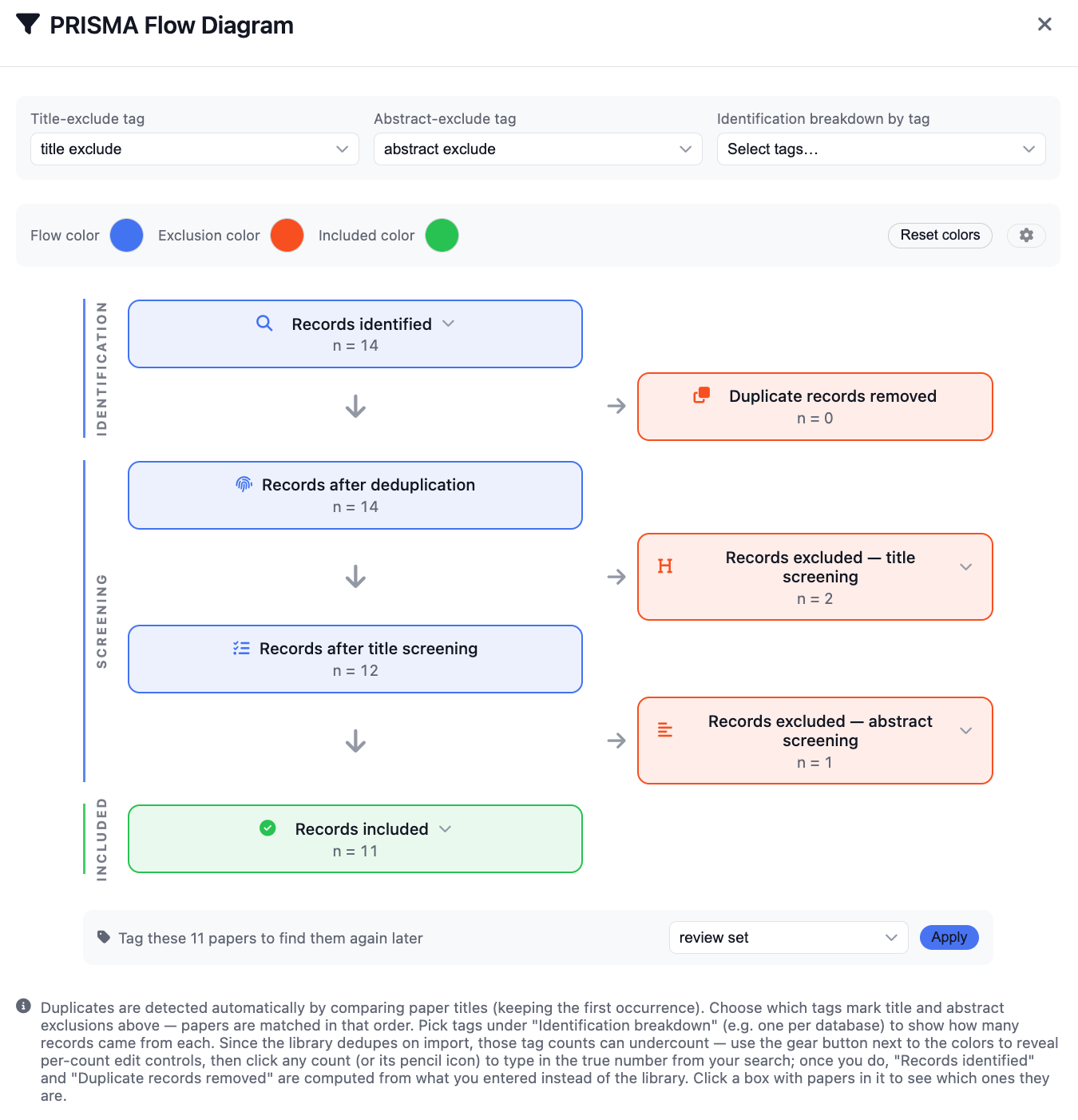
Convert your screening decisions into transparent counts across identification, screening, and inclusion, with explicit exclusions at each stage.

IdentificationRecords identified
DeduplicationDuplicate records removed
ScreeningTitle and abstract exclusions
InclusionFinal records included
Paper Metadata Table

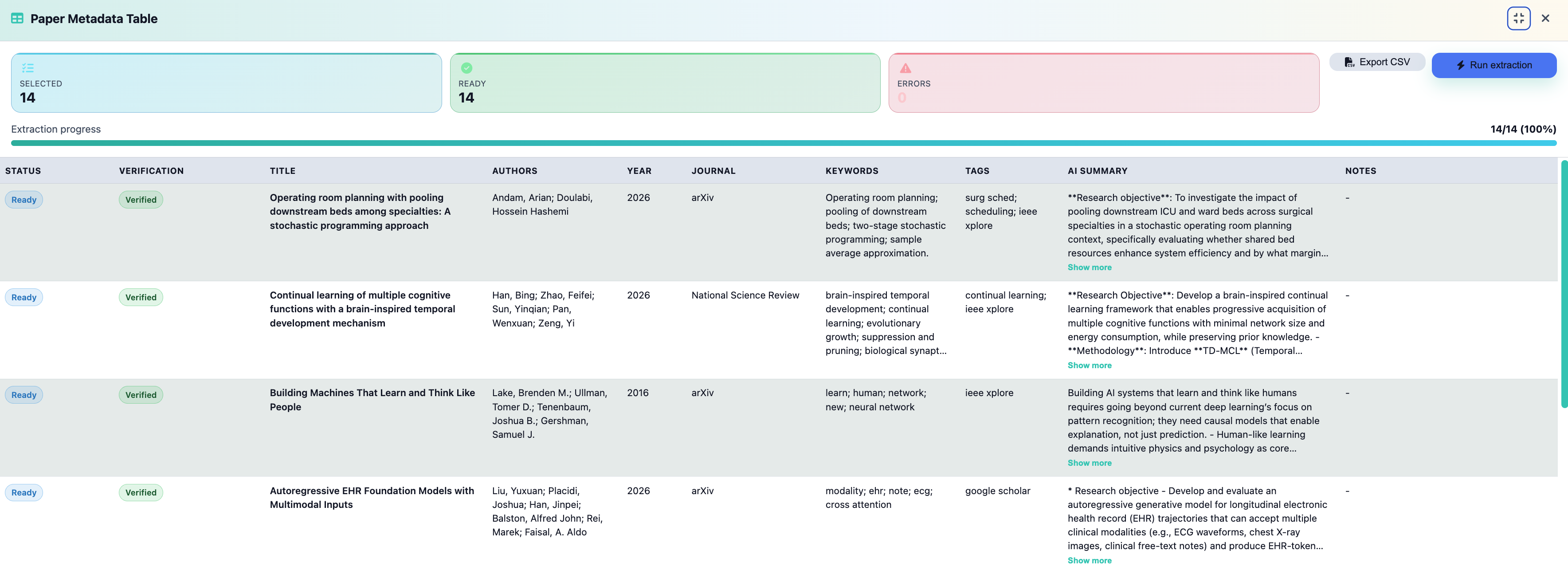
Run extraction for your selected papers and review key fields before exporting. The table is built to support supplemental materials and reproducible review logs.

StatusReady / Errors
CoverageSelected vs Processed
ColumnsTitle, authors, year, journal, tags
OutputCSV for sharing and appendices

UI Figures

Real Review Helper screens for PRISMA flow and metadata export.

Live product UI
Figure 1: PRISMA Flow
CiteGeist PRISMA flow diagram showing records identified, screening exclusions, and included records
PRISMA flow builder. Map title and abstract exclusion tags, then confirm final inclusion counts for transparent reporting.
Figure 2: Metadata Table
CiteGeist paper metadata extraction table with selected, ready, and export controls
Metadata table extraction view. Validate row coverage and click Export CSV for publication-ready tables.

Step-by-step workflow

Use this sequence to generate both the PRISMA summary and a metadata export in one pass.

A. PRISMA flow setup and refinement

1) Configure exclusion tags

Choose which tags represent title exclusions and abstract exclusions so counts map to screening stages correctly.

2) Add identification breakdown tags (optional)

Use source tags to split records identified by import stream, search engine, or query family for deeper traceability.

3) Verify computed boxes

Check Records identified, Duplicate records removed, Records after title screening, Records excluded after abstract screening, and Records included.

4) Save a tagged review set

Tag included papers as your final inclusion set; that label becomes the handoff point to Metadata Table export so you can process, analyze, and keep a clean audit record of included studies.

B. Metadata table extraction and export

1) Select papers and run extraction

Use the Selected count to confirm scope, then click Run extraction. Wait for Ready to match your selected total before exporting.

2) Review AI summaries and core fields

Spot-check title, author list, year, journal, keywords, and tags. Use each paper's Notes field as your margin notes for limitations, key results, findings, and meta-analysis signals. Expand long summaries with Show more where needed.

3) Confirm error count is zero (or understood)

If Errors is non-zero, fix metadata gaps first or document known limitations before final export.

4) Export CSV

From the final inclusion set labeled in PRISMA, click Export CSV in Metadata Table to extract analysis-ready data for processing, synthesis, and long-term record keeping.

Final Inclusion Set -> Metadata Export

After PRISMA finalization, use the same labeled inclusion set in Metadata Table and export CSV for analysis, processing pipelines, and record keeping. Keep Notes updated as margin notes so limitations, findings, and synthesis context travel with each paper into your exported dataset.

Best-practice checks

  • Freeze your search date before final PRISMA counts.
  • Keep exclusion tags mutually exclusive where possible.
  • Use the Notes column like margin notes for limitations, findings, and meta-analysis-relevant details before each export.

Common pitfalls

  • Using a broad tag for both title and abstract exclusions.
  • Exporting before extraction reaches 100% ready status.
  • Changing tagging rules mid-review without documenting rationale.

Export package suggestion

  • PRISMA screenshot or saved figure.
  • Metadata CSV with date and review name.
  • Final inclusion set export from PRISMA labels for transparent analysis tracking.

Next action

Ready to generate your review outputs?

Use the Review Helper in your active project, label your final inclusion set in PRISMA, and then export that set as CSV for immediate analysis.